Dubna science city
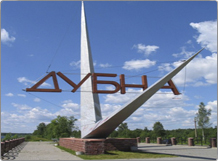
Dubna is one of the young cities of Russia and the Moscow Region. It is known around the world as the largest scientific center. Here, for more than half a century, scientists from many countries of the world have been cooperating fruitfully. Dubna was granted city status on July 24, 1956, which was connected with the creation in March of the same year of the Joint Institute for Nuclear Research — an international scientific center of the socialist countries. During the 1990s, the city managed to preserve its scientific and production profile of activity and laid the foundations for subsequent innovative development.
Since 2000, the city has been experiencing dynamic economic growth. Since 2006, a special economic zone of the technology-development type has been forming in the city. The Russian company "TRACKPORE TECHNOLOGIES" is a resident of the "Dubna" special economic zone of the technology-development type in the Moscow Region.
JINR The Joint Institute for Nuclear Research was established on the basis of an agreement signed on March 26, 1956, in Moscow by representatives of the governments of eleven founding countries, with the aim of combining their scientific and material potential for the study of the fundamental properties of matter. On February 1, 1957, JINR was registered with the United Nations. Today, the member states of JINR are Azerbaijan, Armenia, Belarus, Bulgaria, Vietnam, Georgia, Kazakhstan, North Korea, Cuba, Moldova, Mongolia, Poland, Russia, Romania, Slovakia, Uzbekistan, Ukraine, and the Czech Republic. Intergovernmental cooperation agreements have been concluded with Germany, Hungary, Italy, and the Republic of South Africa. China, which had suspended its participation in JINR, is resuming its ties with the institute. Today JINR is an international organization taking the most active part in leading international projects. Representatives of JINR work at the "Large Hadron Collider" at CERN in Europe, and Dubna itself is preparing to host on its territory the organization's next major project — the International Linear Collider ILC.
JINR
The Joint Institute for Nuclear Research was established on the basis of an agreement signed on March 26, 1956, in Moscow by representatives of the governments of eleven founding countries, with the aim of combining their scientific and material potential for the study of the fundamental properties of matter. On February 1, 1957, JINR was registered with the United Nations. Today, the member states of JINR are Azerbaijan, Armenia, Belarus, Bulgaria, Vietnam, Georgia, Kazakhstan, North Korea, Cuba, Moldova, Mongolia, Poland, Russia, Romania, Slovakia, Uzbekistan, Ukraine, and the Czech Republic. Intergovernmental cooperation agreements have been concluded with Germany, Hungary, Italy, and the Republic of South Africa. China, which had suspended its participation in JINR, is resuming its ties with the institute. Today JINR is an international organization taking the most active part in leading international projects. Representatives of JINR work at the "Large Hadron Collider" at CERN in Europe, and Dubna itself is preparing to host on its territory the organization's next major project — the International Linear Collider ILC.
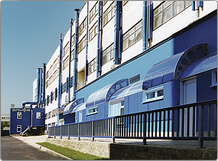
ALPHA sci-tech complex Today, in Dubna, at the ALPHA sci-tech complex, reliable and affordable domestic medical equipment for plasmapheresis is produced. The "ROSA" plasma filter and the "GEMOPHENIX" plasmapheresis device manufactured here are at the level of the best foreign counterparts in their medical parameters, an order of magnitude lower in cost, and unsurpassed in reliability and ease of use. In addition, Western technologies are based on the gravitational method of blood purification. Russian medical equipment based on track membranes, which is produced in Dubna, makes the process more gentle: blood is drawn in small portions through one line, purified through the plasma filter, and immediately returned to the patient through a second line. Speaking at the VI Congress of Allergists and Immunologists of the CIS, Professor Valery Voinov, head of the interclinical department of detoxification and effluent therapy at the Research Institute of Pulmonology of the I. P. Pavlov Saint Petersburg State Medical University, specifically highlighted the role of the company "Trackpore Technologies" in transforming plasmapheresis from an expensive, rarely prescribed procedure into an accessible method of restoring the body's health.
ALPHA sci-tech complex
Today, in Dubna, at the ALPHA sci-tech complex, reliable and affordable domestic medical equipment for plasmapheresis is produced. The "ROSA" plasma filter and the "GEMOPHENIX" plasmapheresis device manufactured here are at the level of the best foreign counterparts in their medical parameters, an order of magnitude lower in cost, and unsurpassed in reliability and ease of use. In addition, Western technologies are based on the gravitational method of blood purification. Russian medical equipment based on track membranes, which is produced in Dubna, makes the process more gentle: blood is drawn in small portions through one line, purified through the plasma filter, and immediately returned to the patient through a second line. Speaking at the VI Congress of Allergists and Immunologists of the CIS, Professor Valery Voinov, head of the interclinical department of detoxification and effluent therapy at the Research Institute of Pulmonology of the I. P. Pavlov Saint Petersburg State Medical University, specifically highlighted the role of the company "Trackpore Technologies" in transforming plasmapheresis from an expensive, rarely prescribed procedure into an accessible method of restoring the body's health.
The "Dubna" special economic zone Special economic zones are territories that the state endows with a special legal status and economic incentives to attract Russian and foreign investors into priority sectors for Russia. By a decree of the Government of the Russian Federation in 2005, Dubna was granted the right to host one of the first four Russian technology-development special economic zones — alongside Zelenograd, Saint Petersburg, and Tomsk. The Dubna SEZ was created for the purpose of developing technology-development activity, primarily in the fields of information and nuclear-physical technologies, and the production of new types of products and services. The special economic zone in Dubna opens up great opportunities for the development of innovative business, the production of technology-intensive products, and their introduction to Russian and international markets. In the "Dubna" special economic zone of the technology-development type, the company "TRACKPORE TECHNOLOGIES" is building the BETA sci-tech complex for the subsequent production of devices and filters for cascade plasma filtration. "Here, in Dubna, a new scientific and economic zone has been created that has transformed the city itself. There is untapped scientific and production potential here, based on 50 years of experience in the work of scientific institutes. The development potential of Dubna as a special science-city zone is considerable," Dmitry Medvedev noted in 2008 when he visited Dubna.
The "Dubna" special economic zone
Special economic zones are territories that the state endows with a special legal status and economic incentives to attract Russian and foreign investors into priority sectors for Russia. By a decree of the Government of the Russian Federation in 2005, Dubna was granted the right to host one of the first four Russian technology-development special economic zones — alongside Zelenograd, Saint Petersburg, and Tomsk. The Dubna SEZ was created for the purpose of developing technology-development activity, primarily in the fields of information and nuclear-physical technologies, and the production of new types of products and services. The special economic zone in Dubna opens up great opportunities for the development of innovative business, the production of technology-intensive products, and their introduction to Russian and international markets. In the "Dubna" special economic zone of the technology-development type, the company "TRACKPORE TECHNOLOGIES" is building the BETA sci-tech complex for the subsequent production of devices and filters for cascade plasma filtration.
"Here, in Dubna, a new scientific and economic zone has been created that has transformed the city itself. There is untapped scientific and production potential here, based on 50 years of experience in the work of scientific institutes. The development potential of Dubna as a special science-city zone is considerable," Dmitry Medvedev noted in 2008 when he visited Dubna.