
The process of producing a track membrane
Despite all the high technologies that underlie the track membrane, a filter based on it is an analog of the lipid membrane of a living cell in the body. How medical filters and devices for membrane plasmapheresis are manufactured, and what their scientific and medical basis is — we will tell on this page.
The accelerator complex
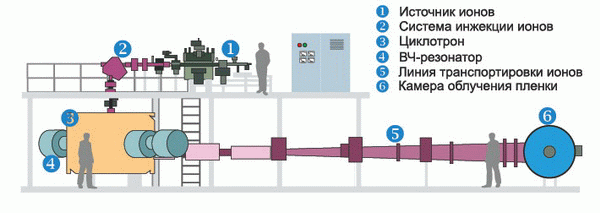
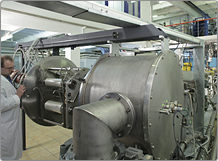
To produce the base of the plasma filter — the track nano-membrane — the first industrial cyclotron in Russia was built. The accelerator complex was designed and built in cooperation with scientists from the Joint Institute for Nuclear Research (JINR). The accelerator is an isochronous cyclotron (the CITREK project) with azimuthal variation of the magnetic field (a four-sector structure), axial ion injection, a high-frequency accelerating system, and an electrostatic extraction system. Along the beam path in the vacuum chamber, argon ions travel at enormous speed, bombarding a lavsan film (usually 10–30 micrometers thick) that is wound from one spool to another (like film stock).
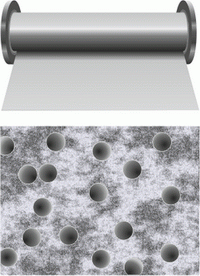
Immediately after the bombardment of the film by ions, there are no pores in it. There are tracks — channels of radiation damage without through-holes. The film then undergoes an ultraviolet treatment stage. The diameter of the resulting pores depends on the energy and type of particle, the material of the irradiated film, and the etching conditions. Varying these parameters gives a very wide range of hole diameters — from 20 nm to 14 micrometers. Throughout this entire range, the main advantage of track membranes is preserved — the ability to specify pore size with high precision, which is very important when it comes to using track membranes in medicine for filtering blood components.
Chemical etching of tracks
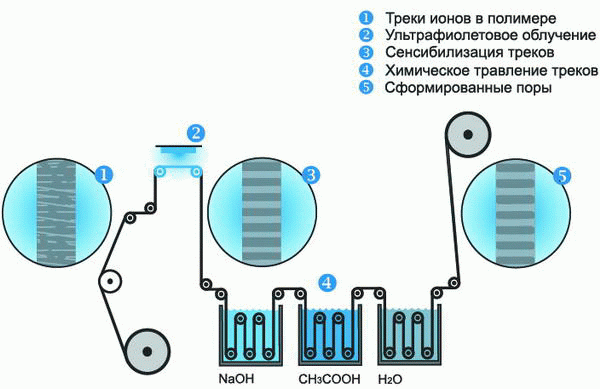
The film is then subjected to chemical etching, which "develops" the trails left by the charged particles — the tracks. By changing the conditions of chemical treatment — temperature, concentration, or exposure time to the chemical — during the etching process, the required size of nano-pores in the membrane can be set. On the same piece of equipment we make membranes with pores of 30 or 50 nanometers. That is, at the chemical treatment stage the pore diameter can be varied over a range of several orders of magnitude. The chief merit of membranes with nano-scale tracks is their stability: the diameter of the final pores varies within 5%. No other technology in the world achieves even comparable results.
Assembly of plasma filters
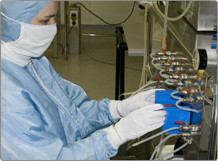
The track membrane is assembled into a package of many layers, sealed in a special way, and placed in a blue plastic cartridge approximately 10x10 cm in size. This is the plasma filter, which separates blood into cellular elements and plasma carrying harmful and toxic substances. Assembling such a plasma filter requires special conditions that are stringent in the requirements imposed: the nano-membranes must be laid into the plasma filter under conditions of absolute sterility. Specifically for this purpose, the so-called clean production zone has been created at the ALPHA sci-tech complex.