
Nuclear technology
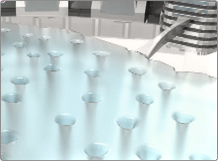
In the world membrane market, Russia has an offering that is rare on a global scale — polymer films perforated with particle accelerators using charged particles. Unlike other types of membranes, they are distinguished by precise adherence to pore sizes — the deviation is only a few percent. They are produced, for example, at the cyclotron of the G. N. Flerov Laboratory for Nuclear Reactions of the Joint Institute for Nuclear Research (JINR) and at the ALPHA sci-tech complex of the company "TRACKPORE TECHNOLOGIES" in Dubna.
Membrane filtration The main purpose of porous membranes is to separate the components of liquids and gases. Pore size determines the range of filtration: from large sand grains to molecules differing in size or charge. The widest areas of application are the medical industry, water purification and desalination, as well as the chemical, metallurgical, and food industries. Membrane material can be a polymer (cellulose, nylon, silicon compounds, etc.), ceramics, or metal. By pore size, membranes for microfiltration (50–3000 nm), ultrafiltration (3–100 nm), nanofiltration (1–7 nm), and reverse osmosis (0.1–1.2 nm) are distinguished.
Membrane filtration
The main purpose of porous membranes is to separate the components of liquids and gases. Pore size determines the range of filtration: from large sand grains to molecules differing in size or charge. The widest areas of application are the medical industry, water purification and desalination, as well as the chemical, metallurgical, and food industries. Membrane material can be a polymer (cellulose, nylon, silicon compounds, etc.), ceramics, or metal. By pore size, membranes for microfiltration (50–3000 nm), ultrafiltration (3–100 nm), nanofiltration (1–7 nm), and reverse osmosis (0.1–1.2 nm) are distinguished.
The first industrial cyclotron The production of track membranes is not merely the fruit of converting experimental facilities. In 2002, the world's first industrial cyclotron was built in Dubna specifically for the production of track membranes for subsequent manufacturing of medical equipment for membrane filtration of blood components — plasmapheresis. Filters based on membranes with pore diameters up to 400 nm retain red blood cells, white blood cells, and platelets, but let plasma pass through. The filtered formed elements are returned to the bloodstream, while a portion of the plasma containing harmful substances is discarded — physiological solution is infused in its place. Plasmapheresis is indicated when it is necessary to get rid of toxins contained in the plasma — for example, in acute poisoning or crush syndrome in people who have spent several hours trapped under rubble. The cyclotron and the filter assembly shop are part of the ALPHA sci-tech complex. The process of producing a track membrane
The first industrial cyclotron
The production of track membranes is not merely the fruit of converting experimental facilities. In 2002, the world's first industrial cyclotron was built in Dubna specifically for the production of track membranes for subsequent manufacturing of medical equipment for membrane filtration of blood components — plasmapheresis. Filters based on membranes with pore diameters up to 400 nm retain red blood cells, white blood cells, and platelets, but let plasma pass through. The filtered formed elements are returned to the bloodstream, while a portion of the plasma containing harmful substances is discarded — physiological solution is infused in its place. Plasmapheresis is indicated when it is necessary to get rid of toxins contained in the plasma — for example, in acute poisoning or crush syndrome in people who have spent several hours trapped under rubble. The cyclotron and the filter assembly shop are part of the ALPHA sci-tech complex.
The process of producing a track membrane
Our technology is unique The production of plasma filters based on track membranes exists only in Russia, although the very idea of obtaining porous films by irradiating them with charged particles followed by etching is American. Academician G. N. Flerov's proposal — to use heavy-ion beam accelerators for producing track membranes — is our unique advantage; and for the first time in the world this method of producing track membranes was carried out in the USSR, while the technology of filtering blood plasma using such membranes is held by the company "TRACKPORE TECHNOLOGIES".
Our technology is unique
The production of plasma filters based on track membranes exists only in Russia, although the very idea of obtaining porous films by irradiating them with charged particles followed by etching is American. Academician G. N. Flerov's proposal — to use heavy-ion beam accelerators for producing track membranes — is our unique advantage; and for the first time in the world this method of producing track membranes was carried out in the USSR, while the technology of filtering blood plasma using such membranes is held by the company "TRACKPORE TECHNOLOGIES".